AMHERST — The University of Massachusetts Amherst athletics department has committed between $25 and $30 million to a plan aimed at reviving the university’s struggling football program.
The investment comes as a surprise to many, given that the team ended the season winless at 0–12, and according to Fox Sports, rank 135th out of 136 teams nationally—extending a losing streak that has stretched for more than a decade.
At a Sept. 24 press conference, the university’s athletic director Ryan Bamford said, “We’re going to have to overinvest to win,” describing the plan as the “deferred maintenance” needed to pull the team out of “no man’s land.”
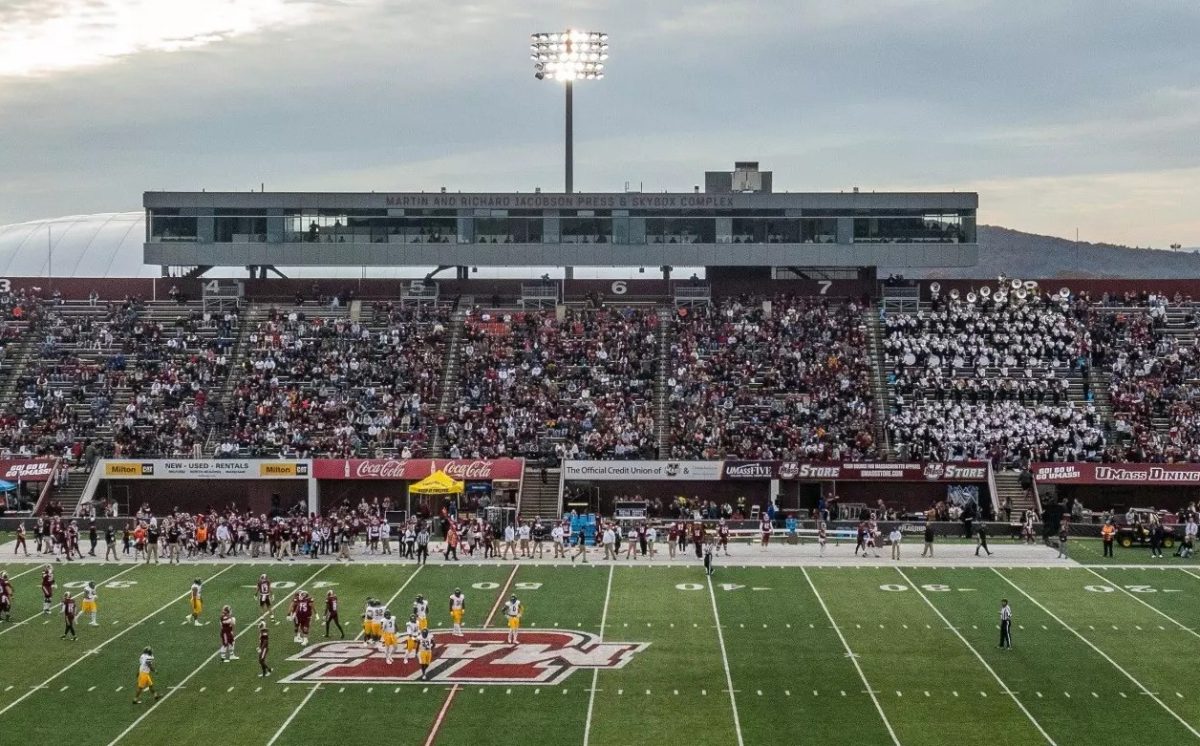
With the money, Bamford plans a three-phase revamp, first focusing on changing the “fan experience” to align with things “integral to the game day experience.” Namely, he’s talking about gutting McGuirk Alumni Stadium, which is infamously one of the least impressive home fields among the NCAA Division 1 schools.
“There will be a complete overhaul” of McGuirk, Bamford said, as updating it, “changing what it looks like and feels like,” will be “very important to the success of the program over the long term.”
The second and third phases will focus on structural elements of the program, such as staffing and roster management.
“We have to now catch ourselves up, and we have to do it quickly,” Bamford says.
Bamford reported that he and his staff are focused on investing money in the right places and with a sound strategy, they’re ready to go into overdrive.
Funding will rely on private money and unspecified “creative funding models” outlined by the university and its Board of Trustees, which Bamford did not further explain.
The program will be taking on debt that decision-makers believe will eventually pay for itself down the line.
As of now, general operating funds from the state of Massachusetts will not be used.
The Faculty Perspective
A UMass professor with a background in college sports as a former college athlete and researcher, expressed skepticism about the plan. He agreed to speak on the matter anonymously, not wanting his comments to reflect poorly on his department or colleagues. He described the new plan for UMass football as one he fears is “sticking a Band-Aid on a much larger issue.” According to the professor, UMass simply isn’t a “sports school.”
When asked to compare UMass to universities in other regions, particularly those in the South, the professor pointed to how “When the [Texas] Aggies played this past weekend, over 100,000 people showed up. There was a campus-wide tailgate, a ticket pool, and an entire week built around one game,” he said. “It’s the same thing for every other major Southern university.”
To him, saying UMass has no sports culture is an “understatement.” Compared to what’s happening down south, there’s barely any buzz on UMass’ campus when the football team has a game. For the professor, that’s a cultural difference. In the South, he explained, sports are institutionalized into academics. “If you don’t play sports in the South you fall through the cracks,” he said.
In Massachusetts, however, priorities are different. “You have to look at how education is structured and where the state government is investing money; there’s a clear difference in focus,” the professor said.
He gave the example that in some parts of the South, it is common to see people join school communities with the primary goal of coaching, and end up also doubling as teachers—sometimes even in core academic classes. He recalled one community where state education funds were cut, resulting in the loss of both regular classroom and special education teachers, only for a $60 million sports bond to later be passed in order to upgrade athletic facilities.
The contrast in priorities– “how that would never happen up North,” he said, is what he appreciates most about Massachusetts as a place to raise young children.
“UMass is a product of the state it comes from. If the State House isn’t funding sports like they do in the South, and instead funds educational programs, then what business does the main state school have behaving like a southern one?”
The professor says he understands where Ryan Bamford is coming from, especially in his role as athletic director, but added that he’s “yet to see evidence that this is going to be a worthwhile investment.”
The Player Perspective
Freshman Elijah Faulkner and sophomore Ramondo Johnson, both members of the team, offered players’ perspectives. Faulkner, who has been playing football since the age of five, expressed deep appreciation for the UMass football program, a feeling he says he’s had since the early stages of his recruitment process.
Faulkner said the Minutemen’s disappointing start this season “doesn’t reflect who we are as a team,” adding that they’re “better than what we’ve been putting out.”
Faulkner called the revival plan “a great thing that’s happening and something that’s going to be put to good use,” but made clear that “money isn’t everything.”
Johnson agreed, saying, “We just need to come together as a team, figure out our mistakes, get better, and learn.”
More than funding, both players emphasized the team’s need for support from their peers. “It’s hard for a football team to have all its energy be internal,” Faulkner said. “It’s special to be in a stadium when the lights come on and the crowd is loud— that’s when players play their best.”
The Student Perspective
Sophomore Patrick Stratford has been a football fan for as long as he can remember. He grew up watching the Patriots every Sunday and says what he loves most about football is “how every team and every player has a story.”
Since coming to UMass, Stratford still spends every weekend watching football. “If I’m not doing anything,” he said, “I’m always watching football, just never UMass football.”
For Stratford, “UMass is tough to root for.” His attachment to the sport comes from getting invested in players’ journeys and wanting to see them succeed. “The UMass storyline is that they suck,” he said.
Logan DeSimone, another sophomore student, had a similar story to Stratford. Having grown up in a football family, he felt his childhood was centered around the sport— what he refers to as an “American dynasty.”
DeSimone said, when applying to UMass, he was “excited” by its Division 1 status and he thought football was “kind of a big deal” on campus. However, no longer a prospective student but an almost second semester sophomore, DeSimone said, “The football team mostly just depresses me.”
In regards to Bamford’s plan, DeSimone said, “I’m glad somebody wants to save the team” but like others interviewed, he fears that UMass’ football problems aren’t solvable by money.
DeSimone agreed with the professor wholeheartedly too, that culture provides an interesting and important lens to UMass’ “football problem.”
As did Johnson, who transferred from West Virginia University and, having grown up in Fort Lauderdale, Florida, has seen the differences the professor described firsthand.
To DeSimone it’s a “chicken and egg situation.” He thinks “students should care about our football team, and they should go to the games even if we’re losing” but he himself does not go and probably never will, “I’m a hypocrite,” he admits.
When told about how the players felt all they really needed was their support of their school, DeSimone said, “it sounds like someone’s got to fold first,” as they “want people to come because they think they’re good, but people won’t because they know they’re not.”
DeSimone said when he sees a win from the Minutemen, he will gladly attend their next game— and he thinks the same would go for a lot of other students.
Stratford also made comparisons to schools in the South. He pointed to the University of Texas, noting that their football players have presence—you see them and you hear about them. Stratford said that just isn’t the case at UMass.
In regard to the new budget, Stratford said “revival” is a fitting title for the plan, “because the team has no pulse.” To him, the plan makes no sense. He doesn’t understand why “we’re going to throw $30 million at rebuilding a stadium for a team that sucks.” Realistically, he said, it’s a waste, especially considering the school has better teams and the fact that its students are going through a housing crisis for dorms.
It won’t be a revival “cool enough to all of a sudden make lots of people want to come here.” “Maybe we go up 10 spots in three years,” Stratford hypothesized, “but it won’t be this huge thing like they say.”
Still, Stratford emphasized that he feels for the football team. He doesn’t believe the program should be cut but that the university should really prioritize the area where they’re actually succeeding, academics.
DeSimone agreed, saying he doesn’t think the program should ever be cut and that he’ll always support its existence. As well as that he supports investing in it— “just not $30 million” and that it really does feel like an “exorbitant amount of money to throw at the program.”
In his opinion, UMass is not being smart with its money. Like Stratford he’s worried about housing at UMass and says the school has a significantly more pressing overcrowding issue that needs to be addressed.
“But they’ve got their money, so I say give them their chance.”
The professor was adamant that reviving UMass football will be no easy task and that the real challenge lies in changing how students view the team. He suggested that an investment in a stronger marketing or public relations strategy may be what the program truly needs. “For this to work,” he concluded, “everyone has to go all in.”