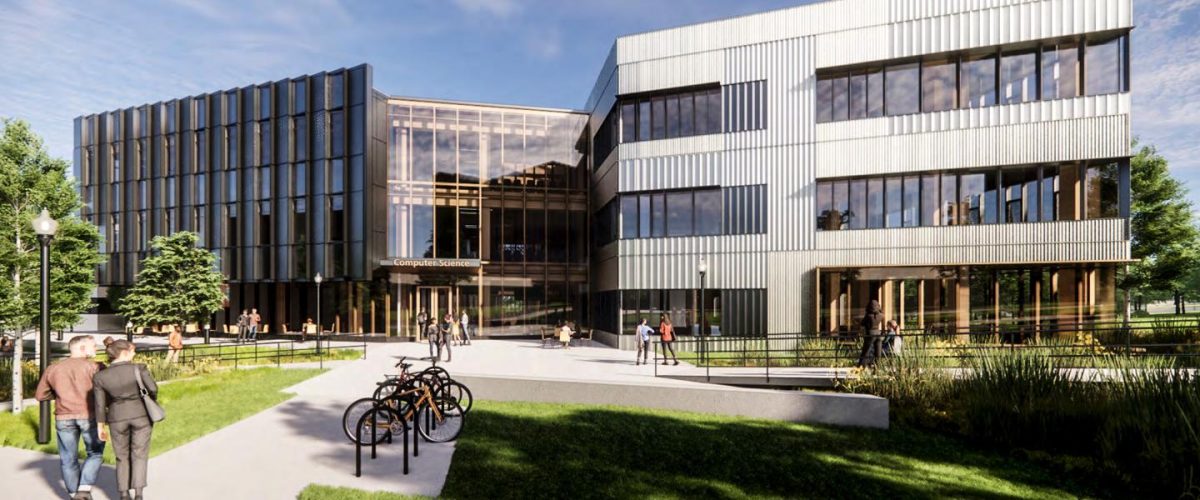
When the University of Massachusetts Amherst broke ground on its $125 million expansion to the Manning College of Information and Computer Sciences in 2022, the goal was clear: build a “state-of-the-art” hub for one of the fastest growing academic programs on campus.
When construction began, university and state officials said the project would be a “world-class” facility built to accommodate rapid enrollment growth and expand research and teaching capacity. What the university did not anticipate was who would actually end up filling the common spaces.
As students settled into finals season this fall, one pattern became unmistakable, nearly everyone studying inside the gleaming, wood-accented, glass-wrapped extension wasn’t a computer science major.
In fact, during multiple visits to the building, every student who agreed to be interviewed, and even the ones who declined because they were deep in exam mode, came from other majors, mostly in engineering. Some weren’t aware of the original computer science building next door.
And yet, these students chose to trek to the far northeastern corner of campus, a zone many described as “kind of out of the way,” to study in Manning’s quiet, sun soaked atmosphere. They all cited the same reason , Manning just feels better.
“I just thought it was really, really pretty,” said Teresa Rodrigues, 20, a junior civil and environmental engineering major who discovered the building only because her club happened to tour it during its construction days. “It’s a nice space to study. There are a lot of little nooks and crannies you can study in.”
Rodrigues had never once visited a computer science building before this semester. Before Manning opened, she usually hunkered down in the library basement or the engineering library, two spaces she described, politely, as less than inspiring. “Engineering buildings are old,” she said. “They have no windows in a lot of the classrooms, and they don’t have study spaces designated for students. So we have to go into other majors’ buildings to find places to work.”
She laughed as she explained the contrast. “This place has a lot of natural light, which is kind of less depressing, versus some of the older buildings.”
Her new study routine reflects it. “Yeah, I come here several times a week. I’ve been here three days in a row,” she said. “It’s definitely a nicer place to study for finals.”
Kevyn Batista, 20, a mechanical engineering major, landed in Manning for similar reasons. He had spent most of his semester bouncing between E-Lab 1, engineering spaces, and South College, until he wandered into the new building “just to check it out.”
“Then I realized it’s super nice here,” Batista said. “Engineering buildings don’t have this many study spaces. Or this much light.” The building’s design stood out immediately, “The high ceilings, the glass, the wood, it’s calming. It reminds me of the Design Building,” referring to the Olver Design Building, one of UMass’s major study hubs, a $52 million facility known for its open, modern architecture.
Even though he lives in Southwest, Batista said the peaceful atmosphere is worth the trek. “It’s quiet. I get stuff done. And it has that new building smell,” he added. Other students described the same draw to Manning, a study space that feels calmer and more intentional than most buildings on campus.
From a graduate student’s point of view, Katie Li, 23, has seen her fair share of overcrowded study spaces. As a computer engineering master’s student, she usually worked in Marcus Hall, where the graduate area was “crowded” and seats were hard to come by.
“There weren’t enough places to sit,” she said. “And the volume was definitely higher.” Manning, she explained, offers an opposing atmosphere, it’s quiet, spacious, and stable. “Immediately it felt new. It’s more open, and I can focus.”
The only proposed challenge, she said, is collaboration. “It’s great for studying on my own,” she said, “but for group work, you have to be volume conscious because it’s all open.” She said she’s noticed enclosed rooms but isn’t sure whether she’s allowed to use them as a non CS student.
Still, Li comes anyway. Even with its location being “kind of out of the way,” Li adds the building’s atmosphere pulls her in. “It’s nice to see the campus build something new. I’m glad I got to use it before graduating.”
The building’s interior, calm, quiet, and filled with natural light from floor-to-ceiling windows and glass walls doesn’t just appeal to students. It also impressed Elizabeth Parolski, assistant director of graduate student success and advising, who moved her office from the old CS building just this fall. “It’s really nice for students to have their own space again, and for it to be pretty,” she said.
Before the expansion opened, graduate students lost their former lounge because it was used to store construction materials. “For this year only, students didn’t have space,” she said. “So when this building opened, it was huge. The graduate lounges are beautiful. One has a fridge and kitchenette, the other has great seating. And they both have conference rooms inside them.”
Parolski said these spaces are more than aesthetic upgrades; they remove real barriers that affect academic success. “Many of our grads live in apartments where every bedroom is taken. Sometimes someone’s using the living room or playing music. It’s stressful to do an interview like that,” she said. “Now they can book a room here and not worry. That makes them more confident walking into an interview, and that’s a big deal.”
She has also enjoyed watching learning happen organically in the open areas. “On the third floor, there’s this work bar that looks like an Apple Genius Bar,” she said. “I’ve seen students actively working out algorithms for their classes on the big whiteboards. It’s cool to see real time learning.”
Parolski watched the building emerge over several years and said she had moments when she doubted it would ever be finished. “They kept saying, ‘We’ll be open by fall 2025,’ and honestly, I didn’t believe it,” she said. “It felt like not a lot was happening, and then all of a sudden, over the summer, everything happened so quickly. It was like watching a time lapse.”
She recalled how meaningful it felt to see the project realized. “To see a building go from an idea to actually getting built and pretty close to on time is amazing,” she said.
Even Professor Subhransu Maji, whose office sits just feet from the new extension, said he has watched the building evolve firsthand. Maji said his office remained in the original Manning building throughout the construction process, giving him a front row view of the transformation.
“I’ve always been here,” he said, referring to his time working in the building before, during, and after the expansion. “It’s really quite nice,” he added, noting that the new extension physically connects his longtime workspace to a facility that will shape the next generation of CS students once classrooms and the auditorium’s officially open.
In a part of campus defined more by traffic lanes than the usual designated student walkways, students from every corner of UMass now make the walk to the far edge of Governors Drive to study in its inviting space.